Libertarian activists Starchild of San Francisco and Justin Tucker of Chicago will offer provocative arguments on the best political arrangement for preserving liberty. Starchild will argue in favor of anarchism, while Tucker will argue in favor of statism.
Each participant will make their case by answering a series of questions:
• Describe your ideal society, and how you think (anarchism or statism) would be conducive to getting
there?
• What do you see as the primary objections to and dangers inherent in your vision, and how would
you address those objections and dangers?
• Are you open to some people within your ideal society having smaller areas or groupings which
are (anarchist or statist)?
• When do you think it is acceptable for an individual or institution to initiate force or fraud against others
without their individual consent, and why?
• What current or past real-world historical examples, institutions, or practices come closest to your
vision?
After the College of Complexes is over, we will meet at Portillo's (3343 W Addison St, Chicago, IL 60618) for dessert, drinks, and to continue the conversation.
Statement of Principles https://lp.org/platform-page/
We, the members of the Libertarian Party, challenge the cult of the omnipotent state and defend the rights of the individual.
We hold that all individuals have the right to exercise sole dominion over their own lives, and have the right to live in whatever manner they choose, so long as they do not forcibly interfere with the equal right of others to live in whatever manner they choose. Governments throughout history have regularly operated on the opposite principle, that the State has the right to dispose of the lives of individuals and the fruits of their labor. Even within the United States, all political parties other than our own grant to government the right to regulate the lives of individuals and seize the fruits of their labor without their consent.
We, on the contrary, deny the right of any government to do these things, and hold that where governments exist, they must not violate the rights of any individual: namely, (1) the right to life — accordingly we support the prohibition of the initiation of physical force against others; (2) the right to liberty of speech and action — accordingly we oppose all attempts by government to abridge the freedom of speech and press, as well as government censorship in any form; and (3) the right to property — accordingly we oppose all government interference with private property, such as confiscation, nationalization, and eminent domain, and support the prohibition of robbery, trespass, fraud, and misrepresentation.
Since governments, when instituted, must not violate individual rights, we oppose all interference by government in the areas of voluntary and contractual relations among individuals. People should not be forced to sacrifice their lives and property for the benefit of others. They should be left free by government to deal with one another as free traders; and the resultant economic system, the only one compatible with the protection of individual rights, is the free market.
Libertarian Party National US https://lp.org/
Libertarian Party of San Francisco https://www.lpsf.org/
Libertarian Party Illinois https://lpillinois.org/
Libertarian Party Chicago https://lpchicago.org/
Libertarian Party Chicago on Facebook https://www.facebook.com/ChicagoLP/

2026 marks 250 years of the Declaration of Independence. This document was a milestone in the history of the liberation of mankind. It was a major instance of Enlightenment political theory becoming praxis.
2026 also marks 52 years since the 1974 Libertarian National Convention in Dallas, Texas, when the pragmatic and radical factions within the LP agreed to take a neutral stance on the existence of the state. This was reflected in the passing of the LP's Statement of Principles. This became known as the Dallas Accord.




August 1
Are Demons Real?
Is Exorcism Effective? Or is it Just a Placebo Effect?
Meeting # 3,865 - Dr, Daniel Herlihy, a Catholic Physician trained to evaluate claims of demonic influence
Dr, Daniel Herlihy, a Catholic Physician trained to evaluate claims of demonic influence, will discuss the question “Are Demons Real”, which will be approached with a disciplined blend of medical science, psychology, and discernment. Daniel points out that in clinical practice, most cases that people attribute to “evil” are rooted in trauma, neurological disorders, psychosis, or severe emotional distress, and his responsibility is always to rule out natural causes through rigorous examination and collaboration with mental health professionals. Yet after exhausting medical explanations, there remain rare situations where a patient exhibits phenomena that defy conventional diagnosis, such as violent aversion to sacred objects, knowledge they should not possess, sudden displays of strength, or a personality shift that appears external rather than internal.
While the Catholic Church considers that demons are fallen spiritual intelligence capable of influencing human beings, and while possession is extraordinarily uncommon, lesser forms of oppression or obsession can manifest in ways that mimic psychiatric illness. Daniel contends that his role is not to declare supernatural causes lightly, but to recognize when a case falls outside the boundaries of medicine and requires the Church’s spiritual authority, He concludes that in these moments, the reality of demons is not treated as a myth, but as a theological possibility supported by centuries of documented cases, and his duty becomes helping the patient navigate both scientific treatment and spiritual liberation with caution, humility, and respect for the mystery of the human person.
August 15
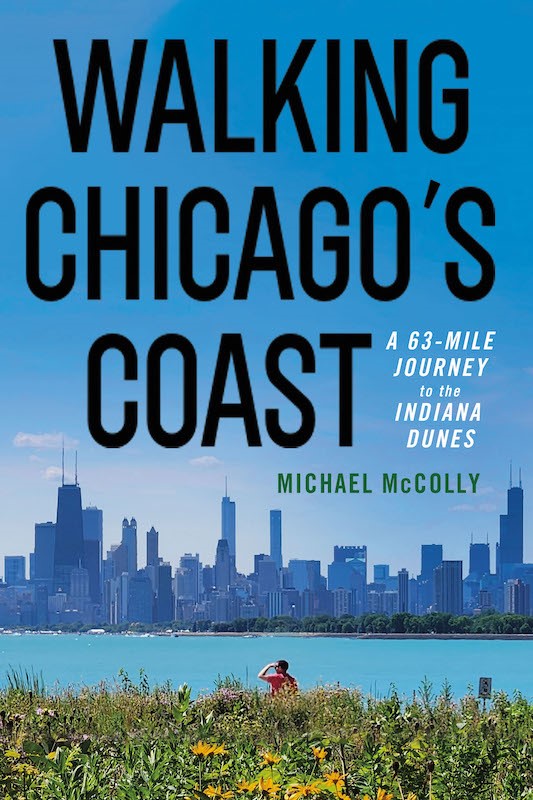
Walking Chicago's Coasts:
A 63-Mile Journey to the Indiana Dunes
Meeting # 3,866 - author Michael McColly
"Part memoir, part travel narrative, part environmental reportage, McColly sews together this metropolis as he walks, reflecting on the city's layers of history and its troubling divides as well as muses on his years living in this grand polyglot mecca of the Midwest. In the end, McColly's walk is a form of advocacy in that he asks us to witness where we live from the ground, so that we can cherish and revere the multiple histories—human and nonhuman--that shape our cities, our lives, and our planetary future."
"McColly's improbable pilgrimage along Chicago's coast testifies to walking's transformative powers. This is a work of great wisdom, tenderness, and defiance destined to be a classic of urban literature." - Rob Nixon, author of Slow Violence and the Environmentalism of the Poor
'McColly shows us the glories and flaws of a great city, its economic and racial divisions, and its devastated outskirts. He also shows us people working to mend communities and restore degraded lands." - Scott Russell Sanders, author of The Way of Imagination
"Michael McColly, in his beautiful new book, adds something new to the walking/thinking/essaying gesture: genuine feeling. Walking Chicago's Coast is a rhapsody of grief and appreciation." - David Shields, author of Reality Hunger
He has been a lecturer in Creative Nonfiction in Northwestern University’s Master’s Program in Creative Writing and at Columbia College.
Book Information: https://www.michaelmccolly.net/



August 29
Debate: Statism vs Anarchism -
What is the Best Political Arrangement for Preserving Liberty?
Meetings # 3,867 - Starchild, Chair of the Libertarian Party of San Francisco; Justin Tucker, College regular and Chicago First Ward Libertarian Committeeperson